American Heartwood
Coming to Cleveland's Holden Arboretum in 2027!
In this series, American Heartwood, I explore the delicate intersection of strength and fragility in nature through the medium of soft pastel. This collection of work showcases endangered trees native to North America, exploring their ecological and cultural importance with visual design cues that highlight the present environmental crisis. Each bold pastel mark is laid down not by chance; the formal design of each piece compels a deeper reflection on our relationship to, and responsibility for, the natural world.
The influence of Craftsman and Art Nouveau styles runs throughout the series, shaping not only the compositional approach but also the message. The Craftsman tradition’s emphasis on natural materials and harmonious design allows for visual elements that refer to uniquely beneficial qualities, such as: providing habitats to other species, suitability for lumber, fabric dyeing, and edible or medicinal qualities. Meanwhile, the organic lines and stylized patterns of Art Nouveau echo the flowing, intricate beauty of nature, contrasting the formal design elements with more organic detail of the leaves, branches, fruit, and bark.
Ultimately, American Heartwood is an invitation to pause and consider what we would do for that which we value in this world. Whether you appreciate nature for its own sake, or for how it impacts your life, we have a collective role to play in ensuring its survival. Through color, texture, and design, I hope to awaken a sense of urgency about the perilous balance of the natural world, inspiring dialogue around conservation and the future of our forests.
In this era of climate uncertainty, I want to ensure that the dangers threatening our native trees do not go unnoticed amidst all the noise. Our natural resources are something many take for granted. There is danger in complacency, and so I seek to banish it by shining a light through the canopy.

Green Ash
Green Ash has a wide natural range, stretching from eastern/central North America, from Nova Scotia west to southeastern Alberta and eastern Colorado, south to northern Florida, and southwest to Oklahoma and eastern Texas. It is well-loved for its tolerance of urban pollution, flooding, and road salt, making it a popular tree for planting in new housing developments. It is an excellent shade tree, turning vibrant yellow in the fall months. The large hanging seed pods provide food to many kinds of native wildlife. It is used by many species of North American frogs as a critical food source.
Like it's relatives in the Ash family, the Green Ash tree is threatened by the invasion of the Emerald ash borer, which will typically kill an ash tree within 3 to 5 years after infestation. Although once popular in urban areas, it is no longer recommended to plant them because there is as of yet no defense against the ash borer. The US Forest Service has discovered isolated "lingering ash" trees in the wild that remain healthy after the emerald ash borer decimates the surrounding population. It is possible that some of these surviving trees have a genetic resistance to the beetle- this is currently being studied in the hopes of fortifying the green ash population.
18x36" soft pastel, 2026
Black Ash
Native to eastern Canada and the northeastern US, the invasive emerald ash borer is decimating many types of ash trees at a rapid pace.
The nearly black stem buds and inner bark give it the common name of black ash. Black ash easily tolerates bogs and swampy areas, along waterways, or in poorly drained areas that often are seasonally flooded. These trees are used by several North American frog and moth species as a critical food source.
Black ash wood is highly flexible and readily separates into thin strips, making it useful in applications requiring bending. It has been used for barrel hoops and chair seats. Native American tradition prefers the wood for many functional items like canoes, axes, snowshoes, and (most notably) baskets.
18x36" soft pastel, 2025


White Ash
Native to eastern and central North America, the white ash is the traditional timber of choice for baseball bats and tool handles. The wood is also a favorite for making furniture and flooring, and has become a popular choice for solid electric guitar bodies.
White ash is critical to North American frogs as a food source, as their falling leaves are particularly suitable for tadpoles to feed on in ponds, large puddles, and other sources of water nearby. In autumn, the trees turn anywhere from yellow to deep purple and maroon.
White ash gets in name because, unlike other ash species, the lower sides of the leaves are lighter in color than their upper sides, lending it a pale look as the leaves flutter in the wind. The species is threatened by the emerald ash borer, and a fungal disease called Ash Rust, as well as other dangers.
18x36" soft pastel, 2025
American Elm
The American Elm was well loved as an urban shade tree for its graceful canopy. It was the most popular tree to plant in the booming cities of the 19th century; many streets were lined only with elms to provide some much-needed shade in summer.
Elm wood was used for barrel staves, trunk-slats, and hoop-poles, and became fundamental to the manufacture of wooden automobile bodies. It's tough fibers hold fasteners securely and resist splitting. The leaves are food for the larvae of a number of species of butterflies and moths.
Sadly, for many years, the American elm has been vulnerable to a devastating pathogen called Dutch elm disease. The widespread planting of elms, while beautiful, illustrated the vulnerability of a monoculture to catastrophic downfall. A healthy ecosystem is one in which a variety of species thrive together.
24x24" soft pastel, 2025


Fraser Fir
Fraser Fir are primarily found in the Appalachian Mountains above 4,000 feet. They are one of the most popular trees around Christmas time. Fraser fir has been used more times as the White House Christmas tree than any other kind.
Unforunately, this tree's population is in decline due to climate change and the invasive balsam woolly adelgid. Seeds are being collected by the Center for Plant Conservation for gene preservation in the hopes that a future solution to the adelgid problem will be discovered. But climate change is still an ongoing threat.
18x36" soft pastel, 2025
Butternut
The framing around the image alludes to butternut's usage in furniture building, wood turning, and fabric dyeing, as well as their edible seeds that are well-loved by humans and animals alike.
Did you know that the yellow-brown of early Confederate military uniforms during the Civil War comes from a dye made from butternut hulls? The later-used grey cloth was not readily available, and this was a homespun alternative.
These trees are rapidly disappearing due to an invasive fungal disease called butternut canker. No control for the fungal disease exists and butternut trees have no natural defenses against it.
24x24" soft pastel, 2025


Eastern Hemlock
The Eastern Hemlock tree has been widely enjoyed by humans across the centuries. It has wood that is often used in construction and the making of railroad ties. It's bark was historically vital to tanning leather, and the inner bark is edible. Tea can be made from it's needles.
These trees create a damp, acidic, and shady spot that is good for amphibians and encourages the growth of several mushrooms such as Hemlock Reishi and Ramaria flavosaponaria. Hemlocks protect the soil from erosion along stream banks, provide food for deer and wildlife, and shelter for deer in winter. Every part of this tree is beneficial to humans and the native ecosystem.
Unfortunately, the hemlock woolly adelgid is an invasive insect that is rapidly impacting the carbon cycle in hemlock stands, and will likely alter the balance of the North American ecosystem, especially in Southern states where the cold can't hold it at bay. This isn't just survival of the fittest- invasive plants and insects cause real damage.
18x36" soft pastel, 2026
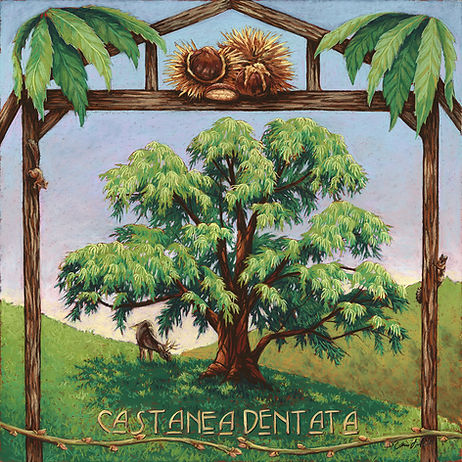
American Chestnut
The American Chestnut is native to eastern North America, especially the Appalachian mountains. It once made up around 25% of eastern US forests, but has almost entirely wiped out by an invasive fungal disease. Chestnuts roasting on an open fire are no longer part of every holiday season.
Chestnuts used to be a plentiful food source for both humans and wildlife. In addition to this well-loved benefit, the leaves were full of nutrients that enriched the soil when broken down by insects.
The lumber was prized for being strong, straight, rot-resistant, and fast-growing. Chestnut trees were once known to grow over 100 feet tall, sometimes called the "redwoods of the East". Unfortunately today, wild trees rarely reach maturity before succumbing to the fungal blight.
The American Chestnut Foundation is working to develop a blight-resistant and Phytophthora-resistant American chestnut tree through scientific research and breeding, and to restore the tree to its native range in the eastern United States.
24x24" soft pastel, 2026